“The highest destiny of humanity is not victory over one another, nor mastery of the Earth, but the wisdom to discover that every life is a thread in the same tapestry. Our best future arrives when strength serves compassion, knowledge serves stewardship, and freedom finds its purpose in the wellbeing of all.”
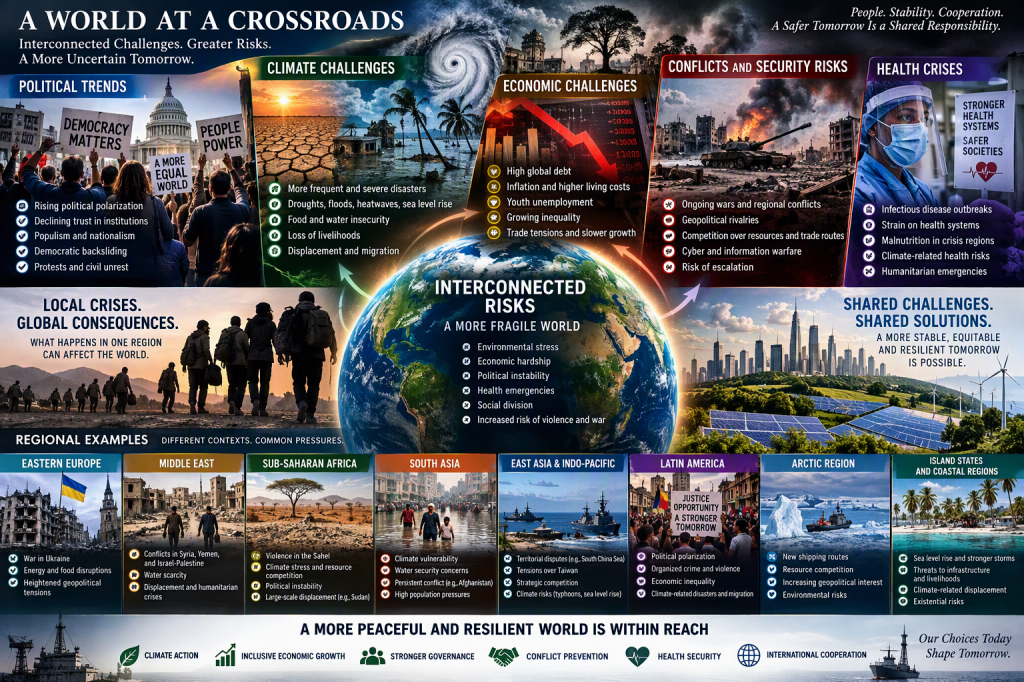
Dear Readers, This is a briefing I developed to summarize the key drivers leading to global conflict nicknamed World War III. This is a top level senior executive brief and does not delve into partisan politics, social ideologies, and major trends found in Mainstream Media or independent information sites found on social media. There are no propaganda tricks to shape emotional responses for or against what is presented. There may be individual distrust of the sources I used to construct this brief. That is a personal matter each reader can assess for themselves. The briefing chart used as an image above is formatted in standard Federal Government format where white space on a chart is hated more than broccoli pie. The chart does highlight a better course for the future if you desire to look at it more closely. This is not an earth shattering revelation. It simply collects and reviews the key drivers that are sources for global stresses that can spill over into political violence at first internal to a state or nation and from political violence the mechanisms for regional or global war are born. The paragraphs, bullets, and references are numbered if one wishes to comment on a specific point the reference number helps readers locate the subject of a comment. Comment and discussion is encouraged. Please be considerate to personal views expressed in comments.
1.0. Global Trends Driving Political Violence and the Potential for War
The modern world is experiencing a convergence of political, economic, environmental, and health pressures that collectively increase the risk of political instability, civil unrest, and armed conflict. While no single factor automatically leads to war, the interaction of these challenges creates conditions that can destabilize societies and strain international relations.
2.0. Political Trends
2.1. Many countries are experiencing increased political polarization, declining trust in institutions, and growing dissatisfaction with governments. Nationalist movements, populist politics, and competition between major powers have become more prominent in recent years. At the international level, strategic rivalry among major actors has intensified, contributing to geopolitical tension and reducing cooperation on global challenges.
2.2. Democratic backsliding, disputed elections, corruption concerns, and perceived inequality have fueled protests and civil unrest in numerous regions. These trends can weaken political legitimacy and create opportunities for extremist movements or violence.
3.0. Climate Challenges
3.1. Climate change is increasingly recognized as a “threat multiplier.” It does not directly cause war, but it can worsen existing tensions over resources, migration, and livelihoods. The United Nations notes that climate impacts intensify competition for food, water, land, and energy resources, especially in fragile states. Major climate-related challenges include:
3.2. More frequent droughts, floods, heatwaves, and severe storms.
3.3. Reduced agricultural productivity and food insecurity.
3.4. Water shortages in already stressed regions.
3.5. Rising displacement and migration caused by environmental pressures.
3.6. According to UNHCR, climate shocks increasingly interact with conflict and displacement, while weather-related disasters have caused hundreds of millions of internal displacements over the last decade.
4.0. Economic Challenges
4.1. The global economy faces persistent pressures from high public debt, trade tensions, uneven growth, and financial uncertainty. The IMF reports that global debt remains extremely high, exceeding 235 percent of global GDP, while rising interest rates and fiscal pressures increase vulnerability for many countries. Key economic risks include:
4.2. Rising government debt burdens.
4.3. Inflation and higher living costs.
4.4. Youth unemployment and underemployment.
4.5. Widening wealth inequality.
4.6. Slower economic growth and trade uncertainty.
4.7. Economic hardship often contributes to political dissatisfaction and can fuel protests, unrest, or support for radical political movements.
5.0. Armed Conflicts and Security Risks
5.1. Several major conflicts and regional crises continue to shape global security. The humanitarian consequences include mass displacement, economic disruption, and regional instability.
5.2. The world continues to experience large-scale displacement due to conflict and violence, with tens of millions of people displaced internally or across borders. UNHCR reports that conflict remains the primary driver of forced displacement worldwide. Current security concerns include:
5.3. Interstate rivalries among major powers.
5.4. Regional wars and proxy conflicts.
5.5. Competition over strategic resources and trade routes.
5.6. Cyber warfare and information warfare.
5.7. Persistent instability in fragile and conflict-affected states.
5.8. As geopolitical competition grows, the risk of miscalculation and escalation remains a significant concern.
6.0. Global Health Crises
6.1. Public health emergencies continue to challenge governments and international organizations. The World Health Organization identifies ongoing threats from infectious diseases, humanitarian emergencies, and climate-related health impacts. Major health concerns include:
6.2. Disease outbreaks such as cholera, mpox, Ebola, and COVID-19-related challenges. – Malnutrition in crisis regions.
6.3. Health system strain caused by conflict and displacement.
6.4. Climate-driven increases in disease transmission and health emergencies.
6.5. WHO reports that climate-related events are a significant aggravating factor in most of the highest-priority global health emergencies.
7.0 How These Factors Lead to Political Violence
7.1. Political violence becomes more likely when multiple pressures occur simultaneously. A common pathway is:
7.2. Economic hardship reduces living standards.
7.3. Climate stress worsens food and water insecurity.
7.4. Governments struggle to respond effectively.
7.5. Public trust declines.
7.6. Social divisions deepen.
7.7. Protests, unrest, or extremist movements emerge.
7.8. Local conflicts escalate into wider political violence.
7.9. Research and international agencies increasingly describe climate change, economic instability, and displacement as interconnected risk factors that can amplify existing grievances and tensions.
8.0. Potential for Future Wars
8.1. The risk of large-scale global war remains lower than during many periods of the previous twentieth century, largely because of economic interdependence and nuclear deterrence. However, several conditions increase the potential for regional or broader conflicts:
8.2. Intensifying super-power competition.
8.3. Competition for critical resources, including water and energy.
8.4. State fragility and governance failures.
8.5. Large-scale migration and displacement.
8.6. Economic shocks and debt crises.
8.7. Climate-driven humanitarian emergencies.
8.8. Most experts view future conflict risks as likely to emerge from the interaction of these pressures rather than from a single cause. The greatest danger is not any one crisis alone, but the convergence of climate stress, economic insecurity, political polarization, armed conflict, and health emergencies creating cascading instability across multiple regions simultaneously.
9.0. Global Trends and Risks of Political Violence: Regional Examples
9.1. The risk of political violence and war is rarely caused by a single issue. More often, conflict emerges when political instability, economic hardship, climate stress, resource competition, and public health challenges reinforce one another. Around the world, several regions illustrate how these pressures interact.
9.2. Eastern Europe
The ongoing war in Ukraine demonstrates how geopolitical rivalry, security concerns, and economic pressures can escalate into large-scale conflict. The war has disrupted global energy markets, contributed to food supply disruptions, and increased military spending across Europe. The conflict has also intensified strategic competition between Russia and Western nations, raising concerns about broader regional instability.
9.2.1. The economic consequences extend beyond the battlefield, affecting inflation, energy security, and government budgets throughout Europe.
9.3. Middle East
9.3.1. The Middle East remains one of the world’s most strategically important and politically volatile regions. Long standing conflicts, sectarian divisions, water scarcity, youth unemployment, and political grievances contribute to instability.
9.3.2. Countries such as Syria, Yemen, and areas affected by the Israel-Palestinian conflict demonstrate how humanitarian crises, displacement, and governance failures can sustain cycles of violence. Water shortages and increasing temperatures add further pressure to already fragile societies.
9.4. Sub-Saharan Africa
9.4.1. Many African states face the combined effects of climate stress, population growth, economic hardship, and weak governance. The Sahel region, stretching across countries such as Mali, Niger, and Burkina Faso, has experienced rising violence linked to armed groups, political instability, and resource competition.
9.4.2. The United Nations and UNEP identify climate change as a threat multiplier in regions like the Sahel, where drought and environmental degradation can increase competition over land, water, and livelihoods. In Sudan, political instability and armed conflict have generated one of the world’s largest humanitarian and displacement crises, illustrating how economic and political breakdown can rapidly evolve into widespread violence. WHO continues to identify Sudan as a major humanitarian emergency.
9.5. South Asia
9.5.1. South Asia contains several nuclear-armed states, dense populations, and significant climate vulnerabilities. Countries such as India, Pakistan, Bangladesh, and Afghanistan face risks associated with extreme heat, water shortages, flooding, and food security.
9.5.2. Afghanistan offers an example of how prolonged conflict, poverty, and environmental stress can reinforce one another. The United Nations notes that repeated droughts and severe climate conditions are worsening humanitarian conditions and increasing vulnerability among millions of people. Water security in major river systems remains a long-term concern, particularly as climate change affects glaciers, rainfall patterns, and agricultural production.
9.6. East Asia and the Indo-Pacific
9.6.1. East Asia is experiencing increasing strategic competition among major powers. Maritime disputes in the South China Sea, tensions surrounding Taiwan, and competing security alliances create the potential for regional crises.
9.6.2. Economic interdependence currently acts as an important stabilizing force. However, technological competition, military modernization, and disputes over trade routes increase the risk that miscalculation or confrontation could escalate into broader conflict.
9.6.3. The region also faces significant climate risks, including typhoons, sea level rise, and threats to critical supply chains.
9.7. Latin America
9.7.1. Although interstate wars are relatively uncommon, many countries in Latin America face political polarization, organized crime, corruption concerns, and economic inequality.
9.7.2. Climate-related disasters, including droughts, floods, and hurricanes, can strain government resources and accelerate migration. Economic stagnation and public dissatisfaction have contributed to large-scale protests in several countries over the past decade.
9.7.3. While these challenges do not necessarily lead to war, they can contribute to political instability and episodic violence.
9.8. Arctic Region
9.8.1. The Arctic is emerging as a strategic area of increasing geopolitical importance. As ice coverage declines, new shipping routes and access to natural resources are becoming available. This raises questions about territorial claims, military presence, and competition among Arctic and non-Arctic powers.
9.8.2. Although cooperation remains significant, resource competition could become a future source of geopolitical tension.
9.9. Small Island States and Coastal Regions
9.9.1. Many island nations and low-lying coastal regions face existential threats from sea level rise, stronger storms, and coastal erosion. These challenges can damage infrastructure, reduce economic opportunities, and encourage migration.
9.9.2. Climate-related displacement has become a growing concern globally. According to UNHCR, weather-related disasters have caused hundreds of millions of internal displacements over the past decade, while climate shocks increasingly interact with conflict and vulnerability.
10.0. Health Crisis Hotspots
10.1. Health emergencies frequently overlap with conflict zones. WHO identifies ongoing humanitarian health emergencies in places including Afghanistan, Sudan, Somalia, South Sudan, Syria, Ukraine, and Yemen. Disease outbreaks such as cholera, mpox, and Ebola can further strain already fragile governments and healthcare systems. Health crises can contribute to instability by:
10.2. Increasing public distrust of institutions.
10.3. Weakening government capacity.
10.4. Disrupting economic activity.
10.5. Intensifying humanitarian emergencies.
10.6. Triggering population displacement.
11.0. Overall Assessment
11.1. The greatest risk to global stability is not a single crisis but the convergence of multiple crises. Regions most vulnerable to political violence are often those where several pressures overlap:
11.2. Weak governance.
11.3. Economic inequality.
11.4. High youth unemployment.
11.5. Resource scarcity.
11.6. Climate stress.
11.7. Large population displacement.
11.8. Ongoing armed conflict.
11.9. Public health emergencies.
11.10. The United Nations describes climate change as a “threat multiplier” because it amplifies many of these existing vulnerabilities rather than acting as a direct cause of war. The most likely future security challenges are expected to emerge where environmental, economic, political, and social pressures converge, creating conditions in which local unrest can evolve into regional instability and, potentially, broader conflict.
12.0. References
12.1. International Monetary Fund. (2025). 2025 global debt monitor. International Monetary Fund. https://www.imf.org/external/datamapper/GDD/2025%20Global%20Debt%20Monitor.pdf
12.2. International Monetary Fund. (2025). Annual report 2025: Getting to growth in an age of uncertainty. International Monetary Fund. https://www.imf.org/external/pubs/ft/ar/2025/
12.3. International Monetary Fund. (2025, October 15). Fiscal Monitor 2025. International Monetary Fund. https://mediacenter.imf.org/news/imf—october-2025-fiscal-monitor/s/a770da3b-295d-41ec-b133-41ba455e02b0
12.4. United Nations. (n.d.). Climate, peace and security: What we need to know. United Nations Peace and Security. Retrieved October 29, 2026, from https://www.un.org/en/peaceandsecurity/climate-peace-and-security-what-we-need-know
12.5. United Nations Environment Programme. (n.d.). Climate change and security risks. United Nations Environment Programme. Retrieved October 29, 2026, from https://www.unep.org/en/what-we-do/disasters-and-conflicts/environment-security/climate-change-and-security-risks
12.6. United Nations High Commissioner for Refugees. (2024). No escape: On the frontlines of climate change, conflict and forced displacement. UNHCR. https://www.unhcr.org/publications/no-escape-frontlines-climate-change-conflict-and-forced-displacement
12.7. United Nations High Commissioner for Refugees. (2026). Global trends: Forced displacement in 2025. UNHCR. https://www.unhcr.org/global-trends
12.8. World Health Organization. (2025). Update on the ongoing public health emergencies of international concern (EB/SCHEPPR/7/3). World Health Organization. https://apps.who.int/gb/scheppr/pdf_files/SCHEPPR7/EB_SCHEPPR7_3-en.pdf
12.9. World Health Organization. (2026). WHO’s work in health emergencies: Update on the response to major ongoing health emergencies (EB158/20). World Health Organization. https://apps.who.int/gb/ebwha/pdf_files/EB158/B158_20-en.pdf
12.10. World Health Organization. (n.d.). List of emergencies. World Health Organization. Retrieved October 29, 2026, from https://www.who.int/emergencies/situations
13.0. In-text Citation Examples
13.1. Climate change is increasingly recognized as a threat multiplier that exacerbates existing social and political tensions (United Nations, n.d.; United Nations Environment Programme, n.d.).
13.2. Global public debt remains elevated and poses long-term economic risks (International Monetary Fund, 2025a, 2025c).
13.3. Forced displacement continues to be driven primarily by conflict, with climate change increasingly worsening humanitarian conditions (United Nations High Commissioner for Refugees, 2024, 2026).
13.4. Ongoing disease outbreaks and humanitarian emergencies create additional pressures on fragile states (World Health Organization, 2025, 2026).
14.0. Parenthetical Citation Key
14.1. (International Monetary Fund, 2025a) = 2025 Global Debt Monitor
14.2. (International Monetary Fund, 2025b) = Annual Report 2025
14.3. (International Monetary Fund, 2025c) = Fiscal Monitor 2025
14.4. (United Nations, n.d.)
14.5. (United Nations Environment Programme, n.d.)
14.6. (United Nations High Commissioner for Refugees, 2024)
14.7. (United Nations High Commissioner for Refugees, 2026)
14.8. (World Health Organization, 2025)
14.9. (World Health Organization, 2026)
14.10. (World Health Organization, n.d.)


Leave a Reply