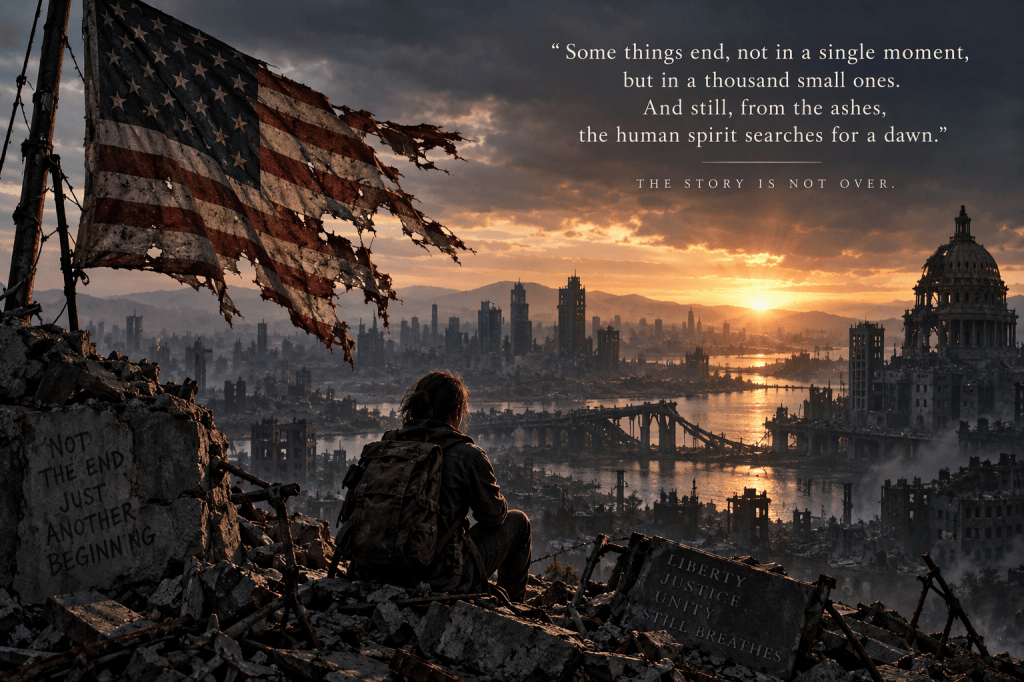
Nations rarely perish in thunder. They fade in the spaces between trust and doubt, memory and forgetting. Yet even after the last banner falls, an idea may linger like an ember, waiting for hands willing to build a fire from its light.
Prolog
I did not see the fall of America all at once. No one did. Collapse is never a single moment, it is a slow unweaving, a fraying of threads that once held a nation together. When I look back now, from the quiet ruins of what used to be a country, I can trace the fault lines clearly. But at the time, they felt like background noise, the kind of distant rumbling you convince yourself is harmless.
The truth is simpler: America did not die in a day. It died the way a mind dies, through contradiction, exhaustion, and the slow erosion of trust.
I remember the first signs. Not dramatic ones. Not riots or fires or speeches. Just a feeling, a heaviness in the air, a sense that people were withdrawing from one another. Neighbors stopped talking. Families split along ideological fault lines. Communities dissolved into isolated islands of suspicion. We were becoming strangers in our own country.
The social fabric tore first. Loneliness spread like a quiet plague. People retreated into digital worlds that fed them different realities, different fears, different enemies. The nation became a mosaic whose tiles no longer touched. We lost the ability to agree on what was true, and without shared truth, unity became impossible. I felt it in myself, the creeping doubt, the sense that every conversation was a battlefield.
Then came the economic unraveling. I watched friends lose jobs to automation and artificial intelligence, watched entire towns hollow out as industries collapsed. The wealth gap widened until it felt like a canyon carved through the middle of the country. The rich fortified themselves behind gates and algorithms; the poor drifted through gig work and debt. The middle class, the old backbone of the republic, thinned into memory. People stopped believing the system could help them. When belief dies, institutions follow.
Government was next. I remember standing in line at a federal office, waiting for a service that never came. The computers were down again. The staff was overwhelmed. The funding had been cut. The building smelled of mildew and resignation. It was a small moment, but it felt symbolic. A nation that once built highways, sent men to the moon, and cured diseases could no longer process a simple form.
Trust collapsed faster than infrastructure. Every election became a battlefield of suspicion. Every institution became a target. Every leader became a symbol of betrayal. Gridlock turned into paralysis. Paralysis turned into decay. And decay turned into something darker, a sense that the republic had lost the will to continue its argument with itself.
But the final blow did not come from politics. It came from nature. The storms grew stronger. The fires burned hotter. The droughts lasted longer. I remember watching a map of the country during the Great Heatwave. Entire regions blinking red, power grids failing, crops dying in the fields. The land itself seemed to be withdrawing its consent to support an unworthy nation.
And then came the cascade. A hurricane that wiped out a coastal city. Cyberattacks that crippled the financial system. Heatwaves that killed thousands. A political crisis froze the government and misinformation surged shattering the last remnants of shared reality.
Each event alone could have been survived. Together, they crushed the republic.
I remember the night the lights went out in my city. It felt like a prophecy. I stood outside and watched the sky, dark and starless, and realized I was witnessing the end of something vast. It wan’t the failure of government or the economy. It was the American story, the one we had been telling ourselves for centuries.
The story of the self‑creating human. The story of the unfinished republic. The prosperous nation that believed it could always repair itself.
When the grid failed, people panicked. When the markets crashed, they rioted. When the government fractured, they fled. And when the storms came, they prayed for meaning. Because that is what collapses first in any civilization: the belief that tomorrow can be shaped.
I survived. Many did. But survival is not the same as living. In the years that followed, America became a memory spoken in past tense. The states fractured. The institutions dissolved. The flag became a relic. And yet, in the ashes, something stirred.
If a nation can die, can it also be reborn? I do not know the answer yet. But I feel the old ideals moving again, like embers beneath the ruin. Liberty, justice, and unity as directions, faint, flickering, and unfinished.
This is where my story begins, in the aftermath, in the quiet resolve to rise. America ended but, the republic, the idea of it, still breathes. I intend to follow that breath wherever it leads.


Leave a Reply