Cold flower heads are raining over my heart.
Oh pit of debris, fierce cave of the shipwrecked. – Pablo Neruda
David woke to the light and sound of birds coming through the window. He was getting used to this natural alarm clock. He lay still for a moment, listening to the soft rustle of palm leaves and the faint cry of birds in the trees. Renate stirred beside him, her hair loose across the blanket.
“Oh, I could lie here all day,” she said.
He nodded. “It is tempting.” His hand wandered along Renate’s back as she stretched.
They ate breakfast on the small table near the open window—bread from the night before, a few slices of mango, and eggs from the boat. The light came in golden and soft, touching the woven walls and the floorboards.
Renate looked out toward the forest. “We should go back to the field,” she said. “See if the goats are still there.”
David smiled. “You are going to make pets out of them.”
“I want to see what else is out there,” she said. “That field looked too neat to be wild.”
They packed their day packs and a lunch. Renate tucked a folded cloth inside for carrying anything they found. David slung his pack over his shoulder and looked at her.
“Ready?”
“Always.”
They left the hut and walked through the clearing, following the same trail. The morning chill was gone, and the forest smelled of damp earth. The sound of the sea faded behind them, replaced by the hum of insects and the occasional call of a bird.
When they reached the field, it was empty. The goats were gone.
Renate frowned. “They were here yesterday.”
David listened. “Hear that?”
From beyond the trees came the faint bleating of goats, mixed with the rustle of branches.
“They’re close,” he said.
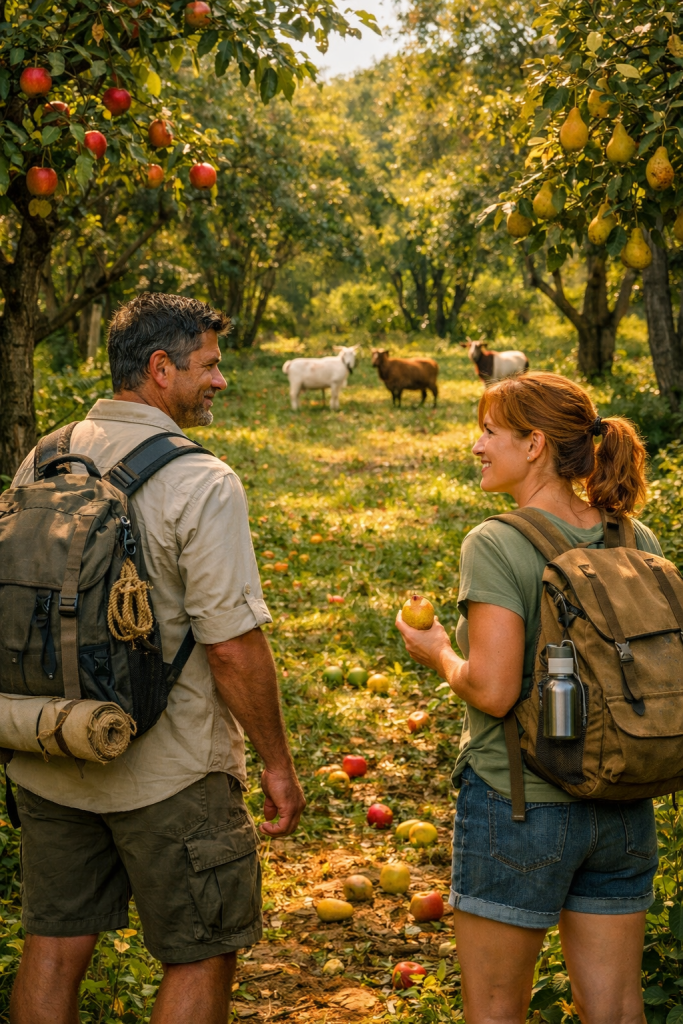
They followed the sound beyond the hedge. The ground sloped gently upward, and the air grew sweeter. Then they saw it—an orchard, sprawling and wild, with trees heavy with fruit.
Apple, mango, and pear. The branches bent under their weight. The goats moved among them, feeding on fallen fruit. Birds darted through the canopy, flashes of color and sound.
Renate stopped and stared. “David, look at this.”
The orchard stretched for acres, the trees thick and mature. The ground was littered with fruit, some fresh, some rotting.
“This isn’t wild,” he said. “Someone planted this.”
Renate walked to a pear tree and picked a pear. It was golden and soft, the skin warm from the sun. She held it up.
“Pears. We can make wine.”
David smiled. “I like the way you think.”
“I’m thinking of home,” she said. “This makes it feel possible.”
They wandered through the orchard, moving slowly, examining the trunks of old trees. The goats followed them at a distance, curious but cautious.
Renate looked around. “This is too big for one person. There had to be people here.”
David nodded. “A plantation, maybe. Long ago.”
They found no huts, no tools, no signs of recent life. Only the trees, the fruit, and the quiet hum of the island.
Beyond the orchard, the land opened again. They found a field of pineapples, their spiky crowns catching the light. A grove of bananas stood nearby, the leaves broad and green. Coconut palms rose beyond them, tall and straight.
Renate picked a few mangoes and pears, placing them carefully in her cloth. “We’ll take these back.”
David looked toward the far side of the grove. “There’s something there.”
She followed his gaze. A mound of rock rose in the center of a circular stand of trees. The formation was strange—too round, too deliberate.
“Let’s see,” she said.
They walked toward it, the ground soft with fallen leaves. The air grew cooler under the canopy. The mound was covered in moss and vines, the stones large and weathered.
David ran his hand over one of them. “This was built.”
Renate looked around. “Maybe a foundation. Or a wall.”
“Or a grave,” he said quietly.
She didn’t answer. The forest was silent except for the distant sound of goats and the flutter of wings.
They stood there for a long moment, looking at the stones and the circle of trees around them. The place felt old, older than the orchard.
As the couple walked slowly around the rock formation, David said, “Look, someone packed soil around the perimeter to build up a mound.”
“It looks like they were trying to fill in gaps, maybe to keep nature out,” Renate said.
They scrambled up on the mound. Renate pointed out where the boulders intersected. “Wow, all the crevices are packed with soil and moss.”
“Look, babe.” David pointed to a chimney built of small stones and clay poking up from the highest point of the rock mound. “This is their home. It’s like an impregnable fortress.”
The weight of their discovery held them in silence.
Renate finally broke the silence. “Whatever it was, it’s part of the story.”
David nodded. “And we’re part of it now.”
Climbing down, they continued to walk around the structure. “Look at this indentation, like a cove in the rock. All of this heavy brush blocking it looks like camouflage.”
“Darling, there is something back there like a wooden door. Can you see it?” Renate pointed beyond the brush.
“I’m going to see if I can get back there.” David pushed through the brush.
David called out. “My god, it’s a wooden door, and it’s thick. I can see that it’s sealed with clay around the edges.”
Renate drew in her breath and felt a cold shiver down her spine. “If it’s sealed from the outside, maybe it is a tomb.”
David emerged from behind the brush. “Whatever it is, I didn’t bring the right tools to get in. My inner Indiana Jones is telling me there is more to this than we can imagine.“
“I’m not feeling good about this. Let’s go.”
They turned back toward the orchard. Renate carried her bundle of fruit, and David walked beside her, his pack pressing into his shoulders.
When they reached the edge of the field, Renate looked back once more. “We’ll come again,” she said.
David smiled. “Okay. But I need to bring a few more tools and the flashlight. That door was well-built; there’s no chance of breaking in. I might be able to remove the clay and find a way to pry it open.”
They walked on toward the hut, their discovery weighing on their minds.


Leave a Reply