“The stone remembers what the sea forgets.
Beneath its silence, the old voices wait —
not for worship, but for those who listen.” – Songs of the Elders
The new islanders awoke a little later than usual and lounged sleepily in the bed.
“The bed is so comfortable, I almost don’t want to get up,” Renate said softly. She stretched and yawned.
David smiled. “That was a good one. I’m jealous.” He rose slowly out of bed and began gathering the coffee tin and cups, then filled the percolator with fresh water. Renate started the camp stove and placed the percolator on the fire.
They lingered longer than usual, the quiet between them easy and warm. The hut began to fill with sunlight streaming through the windows. Renate made breakfast—fruit, bread, eggs, and coffee—and they ate slowly, talking about the mound.
“We should look inside,” she said.
David nodded. “We’ll take tools. Just in case.”
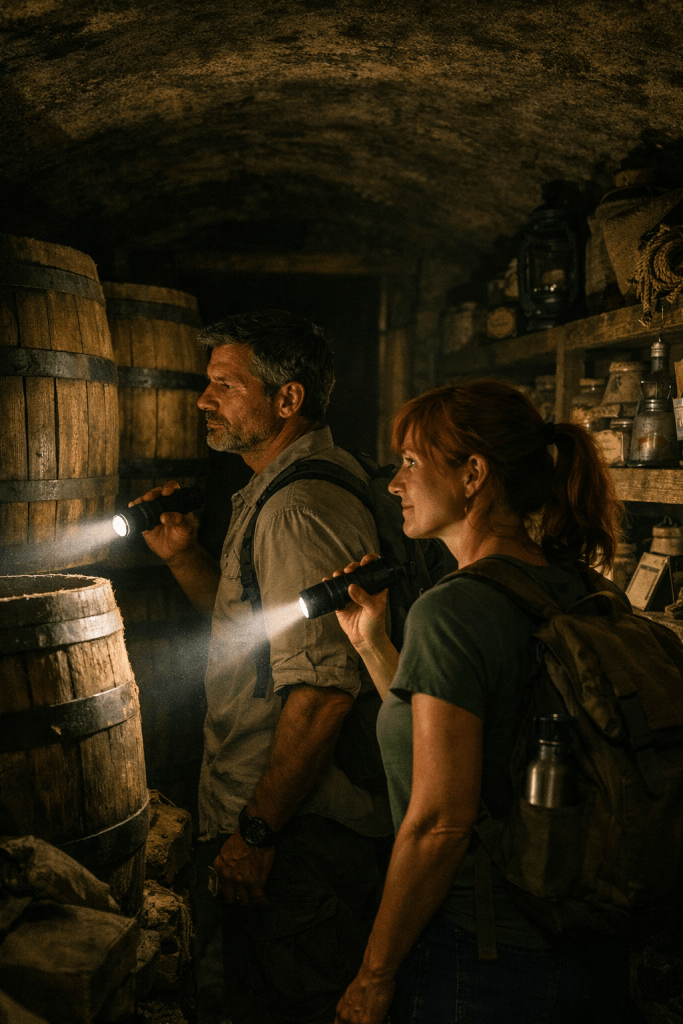
They packed their lunch and added two flashlights, a crowbar, a chipping hammer, and gloves. David checked the batteries and slipped the hammer into his belt. Renate filled two flasks with water and tucked one into her pack and the other into David’s.
The walk to the grove was quiet. The forest was alive with birds, and the air grew cooler under the canopy as they neared the mound. The trees formed a circle around it like a perimeter guard. The stones, covered in moss and vines, created a scene from the distant past. The island was slow to yield its mysteries, and the two explorers were fully under its spell.
David set down his pack. “Let’s clear the entrance.”
Renate took the machete and began trimming the brush. The vines came away easily, revealing a rough outline of a door made from heavy wood and iron bands.
“It’s old,” she said.
“Very old,” David said. “It reminds me of the kind of doors that castles had to defend the Keep.”
They worked together, cutting and pulling until the doorway was clear. The hinges were rusted but solid. David wedged the crowbar into the seam and leaned his weight against it. The door groaned but held.
Renate leaned in to give a hand. “Try again.”
The wood cracked, and the door shifted. A smell came out—dust, stone, and something faintly sweet, like old wine.
“One more,” he said.
The door gave way with a dull creak. They stepped back as it swung open.
Inside, the light from their flashlights cut through the darkness. They saw a room carved into the rocks, with a low, curved ceiling.
Renate whispered, “Look at this, it’s much finer than the outside would ever suggest.”
David nodded. “Someone lived here. The rocks are pointed with lime, probably made right here on the island.”
They stepped inside. The air was cool and dry. Against one wall was a bed, simple and narrow, covered with a faded blanket. A table and chair stood nearby. The chair had a goat leather seat and back, and at the far end was a fireplace built into the stone.
Renate moved her light along the wall. “Look at this.”
Small oak barrels were stacked neatly, their wood dark with age. A wide rack held long objects wrapped in coarse cloth and twine.
David examined one of the barrels. “Still sealed.”
Renate unwrapped a corner of one of the long bundles. “Rifles,” she said quietly.
David looked closer, feeling the bundles. “Percussion cap muskets. And cartridge-style rifles. They’re well preserved with some kind of oil.”
They moved slowly through the room, careful not to disturb anything. The sounds were heavy and muted. They had discovered a forgotten history of the island.
Renate turned her light toward the center wall. “There’s another door.”
David walked over and tried the handle. It was stiff but moved. The door opened into a narrow landing. A ladder descended into darkness.
Renate shone her light down. “It goes deep.”
David tested the first rung. It was solid. “Well built.”
They climbed down, one after the other. The air grew cooler, the smell of earth stronger.
At the bottom was a large room, wider than the one above. The walls were lined with shelves and racks. Barrels filled the space, all sealed tight.
Renate ran her hand over one. “These were probably here for storage.”
David nodded. “Supplies the owners wanted to keep preserved.”
They found tools—axes, shovels, saws—each wrapped in oilcloth. There were plow shares and other farming tools. On a shelf sat a bound ledger, its leather cracked but intact.
Renate opened it carefully. The pages were yellowed but legible. “It’s written in French.”
David leaned over her shoulder. “Any dates?”
She turned a few pages. “1757. Then 1762. It goes on.”
She flipped ahead. “Stops at 1890.”
They looked at each other.
“A garrison?” she said.
“Maybe,” he said. “Or a trading post.”
Renate closed the book. “Why here?”
David looked around the room. “A stopover, maybe. Ships coming through for resupply.”
They climbed back up to the main room. The light from the doorway was dim now, the sun outside beginning to lower into late afternoon.
Renate looked at the rack of rifles again. “They’re in good shape.”
David nodded. “Yes, especially considering their age.”
She smiled faintly. “We’ll leave them for now.”
He agreed. “We’ve done enough for one day.”
They stepped outside. The air was warm again, the forest alive with sound.
Renate looked back at the mound. “It’s strange.”
David nodded. “It’s history, but who’s history?”
They walked toward the orchard, the light turning golden through the trees. The goats were grazing in the distance, and the fruit hung heavy on the branches.
Renate picked a pear and handed it to him. “Should we come back tomorrow?” she said.
“I think we should examine all of the supplies to see if any of them are useful. The rock pile is a perfect place to store things. We can bring back anything we want to keep at the hut,” he said.
They walked on, the island quiet around them, the mound behind them holding its secrets slowly disappearing behind the trees.


Leave a Reply