Codex from the Order of the Rose
“Some worlds do not awaken — they are already awake. Their stones are fragments of a greater mind, their winds the breath of a memory older than stars. To be recognized by such a place is no small fate: it means the cosmos has turned its attention toward you.”
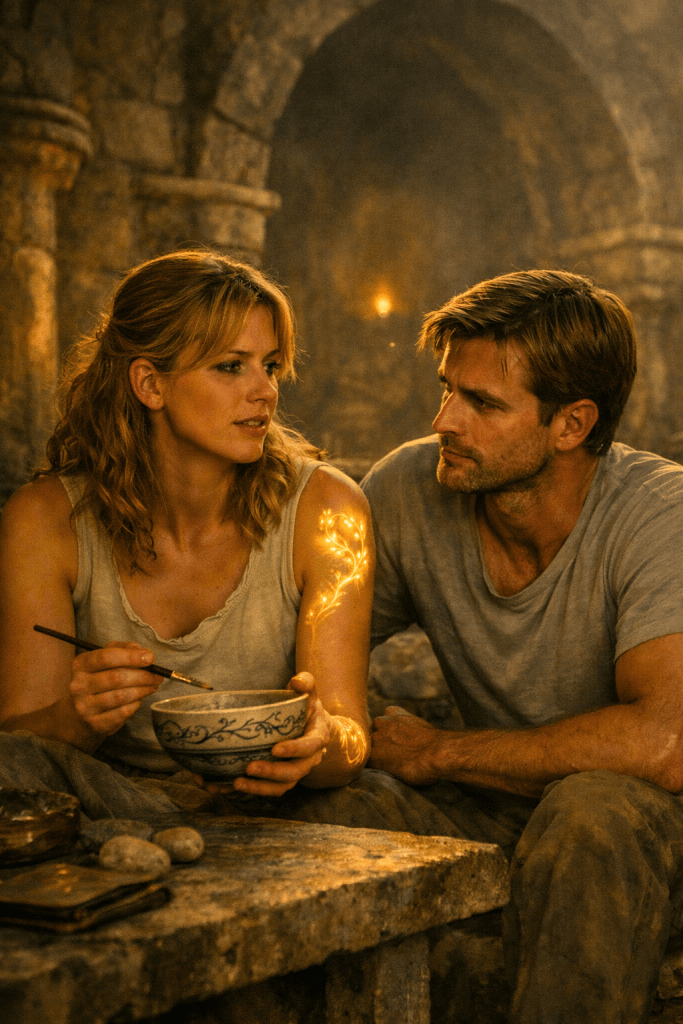
The birds stayed in the branches long after the glow beneath Renate’s skin faded. They didn’t sing. They didn’t move. They only watched.
Renate stood very still. David could see her breathing change, become slower, and deeper, as if she were listening to something far away.
“David,” she said quietly, “the island knows a lot of secrets.”
He didn’t ask what she meant. He felt it too, a pressure in the air, soft but present, like the moment before a storm breaks, except there was no storm. Only sunlight and the rustle of leaves.
Renate looked down at the bowl she had painted. “These patterns, they weren’t memories. They were instructions.”
David frowned. “From the cave?”
“From the island,” she said. “The cave is just where it speaks.”
She touched her shoulder again. The rose‑vine didn’t glow now, but he could see the faint shimmer beneath her skin, like embers cooling.
David stepped closer. “What did you feel a moment ago?”
Renate hesitated. “Recognition. Like something old was opening its eyes.”
He nodded slowly. “The Order?”
“Older than the Order,” she said. “The monks didn’t create the rose‑vine. They only tended it. They said it was a gift from a place that remembered more than people ever could.”
David looked toward the forest. “This place.”
Renate nodded. “Yes, and probably more. Like the wall glyphs we saw in Terra del Fuego, or the abandoned city in the Ecuador forest where you found the underground treasury.”
David’s eyes opened wider as he remembered those past experiences. “Those strange lizards that guarded the tunnels.”
Renate nodded slowly, remembering. “Yes, they almost got you.”
The birds shifted all at once, a soft ripple of feathers. Renate turned toward them.
“They’re waiting,” she said.
“For what?” David asked.
“For us to go to the cave.”
He didn’t like the sound of that, but he didn’t say so. Instead he picked up one of the glazed jars. The blue line he painted earlier had darkened, deepened, and was almost dry.
“Renate, look at this.”
She stepped closer. The glaze had dripped and formed a pattern he hadn’t painted, a branching line, curling like a vine.
Renate touched it lightly. “It’s the same shape.”
“The rose‑vine?” he asked.
“It does look like it,” she said. “The island’s memory is becoming our reality the longer we stay.”
David looked at her. “How can a place have memory?”
Renate didn’t answer right away. She looked toward the trees, toward the hidden path that led to the carved cave mouth.
“When the monks brought me into the Cathedral, they told me the rose‑vine wasn’t a mark of power or identity. It was a mark of connection. A way of feeling what most people cannot.”
David waited.
“They said the world has places where earth’s memory gathers,” she continued. “Places where time folds. Places that remember everything that’s ever touched or happened to them. People have learned how to read the history of a place through the geologic record but we never think of it as the land’s memory of its existence.”
David felt a chill. “And this island is one of those places.”
Renate nodded. “Maybe the strongest one.”
The birds rustled again. A few hopped to lower branches, closer to them.
David swallowed. “Renate, what does the island want?”
She closed her eyes. “I feel it wants connection with us.”
“Why?” he asked.
She opened her eyes. “Because we seem to be the first people to stay here in a long time and act like good stewards to the islands plants, wildlife, and resources.”
David stared at her. “Is this connection to the island possible?”
Renate shook her head. “I don’t know. The island doesn’t measure time or connection the way we do.” Holding the glazed bowl as if trying to read it, Renate continued. “We have always respected the land we visited and it has always revealed its secrets to us, given us its bounty for us to use. The island is the same and even more so. Because we made this our home, it has rewarded us with all we need to live here.”
He didn’t know what to say to that. He only knew the truth of her voice, the certainty in it.
Renate looked at her shoulder again. “The rose‑vine woke because the island recognized me.”
“Where would I fit in?” David asked.
She looked at him, her expression softening. “It recognized you first because you gather the resources and we build almost everything by hand. It’s like we are already connected to the island and depend on it.”
The birds fell silent again. The air grew still.
David felt the pull, gentle, steady, unmistakable.
“The cave,” he said.
Renate nodded. “It’s calling stronger now.”
David took her hand. “Are you ready?”
“No, but I think we have to go anyway.”
He squeezed her hand. “Then we go together.”
The birds lifted from the branches all at once, rising in a single sweeping motion, circling above them like a sign.
Renate watched them. “The island wants to connect with us on a deeper level.”
David looked toward the forest. “Then we should see what this mysterious cave wants to show us.”


Leave a comment