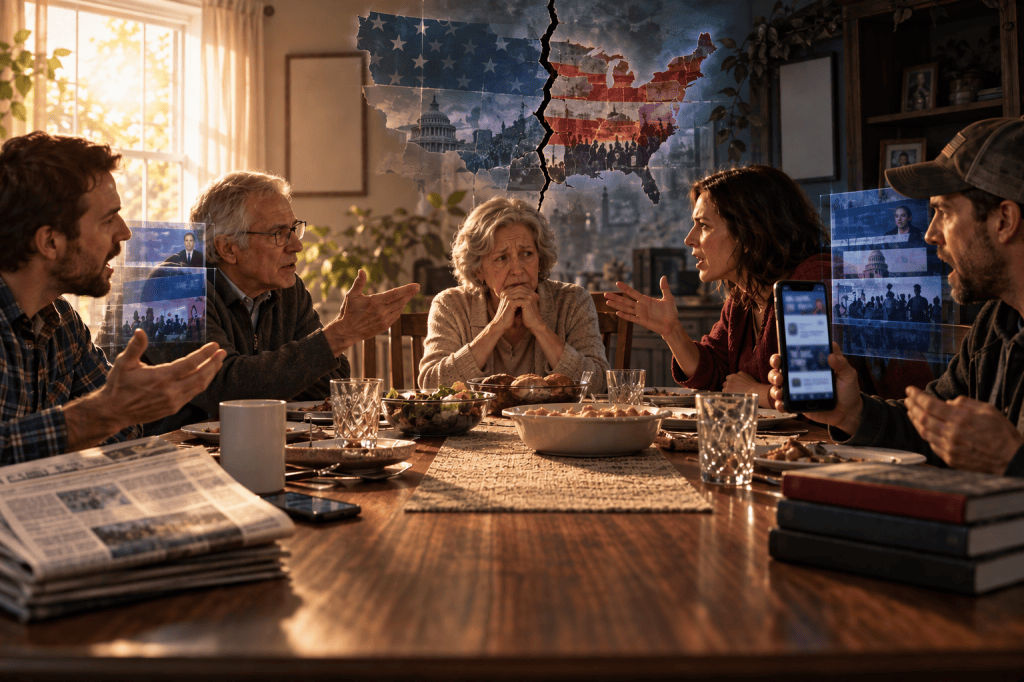
The republic did not divide along borders. It divided across dinner tables, living rooms, and the silent spaces between people who once trusted one another.
The Argument That Never Ends
My family gathered in my sister’s dining room on a warm Sunday afternoon, the kind of day that once carried an easy feeling. The table was set with familiar dishes that had appeared at every holiday and birthday for as long as I could remember. Sunlight filtered through the curtains, casting soft patterns across the wood grain. For a moment, the room felt suspended in a memory of better years. Yet beneath that surface, a tension pulsed like a hidden current. I sensed it in the way we sat, shoulders slightly raised, eyes alert, as if waiting for something we could not name.
Conversation began with the usual pleasantries, but each remark carried an undertone that unsettled the air. My brother commented on a recent news story, and my uncle responded with a different version of the same event. Their voices sharpened as they tried to assert their interpretations. The shift was subtle at first, a slight change in posture, a tightening around the eyes. Then the room tilted. The discussion no longer resembled a shared attempt to understand the world. It became a contest of narratives, each person defending their chosen reality with the fervor of someone protecting a fragile identity.
The argument grew louder, not because the topic mattered, but because the performance mattered. Every sentence was delivered with the cadence of a speech, shaped for an invisible audience rather than the people sitting at the table. My sister leaned forward, her hands clenched, insisting that her sources were reliable. My uncle countered with equal conviction, citing voices that lived in a different informational universe. My brother raised his phone like a talisman, scrolling through posts that reinforced his position. The devices glowed between us, feeding the fire with curated certainty.
I watched the faces around the table and felt a heaviness settle in my chest. No one was listening. They were reciting. The room had transformed into a stage where each person performed a role shaped by fear, pride, and the need to belong to something larger than themselves. The argument moved in circles, repeating the same points with increasing intensity. The air thickened with frustration, and the warmth of the afternoon faded beneath the weight of competing truths. I felt as though the walls were closing in emotionally, compressing the space until connection became impossible.
My mother tried to intervene, her voice soft and steady, but her words dissolved before they reached anyone. The momentum of the conflict carried the room forward, pulling each person deeper into their own convictions. I saw the strain in her eyes, the quiet grief of someone watching her family drift apart. She looked at me as if hoping I could stop the unraveling, yet I felt powerless. The argument had taken on a life of its own, fueled by forces that extended far beyond the dining room. It was a disagreement. It was a symptom.
As the voices rose, I felt the first tremor of something larger than family discord. The fracture I had sensed in the neighborhood now revealed its deeper nature. It lived in the way people clung to their beliefs with desperate intensity, as if the loss of a viewpoint meant the loss of identity. It lived in the way conversation had transformed into combat, each word a weapon, each pause a retreat. The room vibrated with the energy of a nation splitting along invisible seams. The argument was endless because the fear beneath it was endless.
I sat back and let the voices wash over me. The sound carried a strange rhythm, rising and falling like a storm building strength. I felt the despair of witnessing something intimate and irreplaceable slipping away. The people I loved were still present, yet they seemed distant, shaped by forces that had hollowed out the center of our shared life. The fracture was no longer quiet. It had found its voice, and it echoed through the room with relentless force.
When the argument finally exhausted itself, the silence that followed felt heavy and unnatural. No one looked at one another. Plates sat untouched. The sunlight had shifted, casting longer shadows across the table. I felt a chill move through me, a recognition that the collapse had already begun. It lived in this room, in these voices, in the inability to hear one another. The fracture was not an abstract idea. It was here, unfolding in real time, reshaping the bonds that once held us together.
I left the gathering with a sense of unease that clung to me long after I stepped outside. Things felt uncertain in my mind as I tried to figure out why the argument happened in the first place. I understood then that the argument was not an isolated moment. It was a reflection of a deeper national unraveling, a sign that the republic’s foundation had begun to shift. The tremor was small, yet unmistakable. Something vast was changing, and none of us were ready for it.


Leave a Reply