“A nation does not fracture when people disagree. It fractures when they can no longer recognize the same reality.”
The Digital Divide
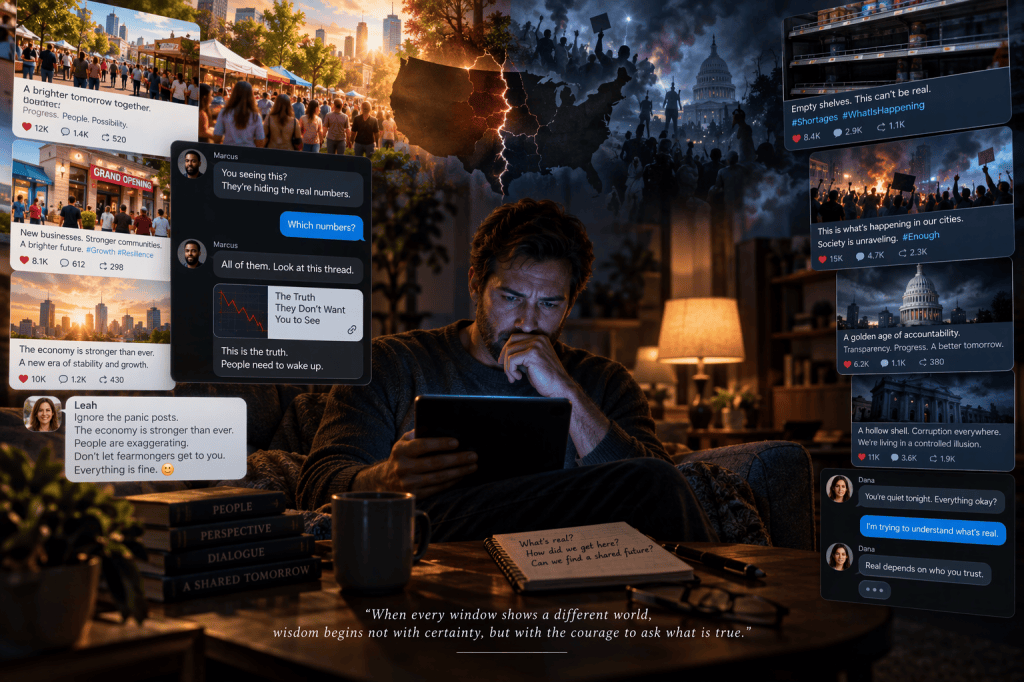
I sat on the couch that evening with my tablet resting in my palm. The room around me was quiet. The world outside had already retreated into its private chambers. The only light came from the pale glow of my tablet screen. I opened my social feed without thinking, guided by habit rather than intention, and the first images appeared with a vividness that felt almost intrusive. They showed a country thriving, streets filled with smiling crowds, new businesses opening, and commentators praising a season of prosperity. The colors were bright, the tone triumphant, and the message unmistakable. According to my news feed, everything was rising.
I scrolled further, and the tone shifted abruptly. Another friend had posted a video of empty shelves in a grocery store, the camera shaking as they narrated a story of shortages and fear. Their voice carried a tremor that made the scene feel urgent. Comments beneath the video insisted that the nation was in freefall, that institutions were failing, and that danger was spreading through every city. The contrast between personal accounts and public reporting created a strange dissonance, as if I were looking through windows into different countries that shared the same name. I felt a tightening in my chest as I moved between them, trying to reconcile the contradictions.
A message popped up from my friend Marcus.
“You seeing this? They’re hiding the real numbers.”
I typed back, “Which numbers?”
He responded immediately.
“All of them. Look at this thread.”
He sent a link filled with charts and warnings, each presented with the certainty of someone delivering a prophecy. The thread insisted that the nation was collapsing under the weight of corruption and mismanagement. The tone was absolute, leaving no room for doubt or nuance. I read through the comments, each one reinforcing the same narrative with increasing intensity. Marcus wrote again.
“This is the truth. People need to wake up.”
Before I could respond, another notification appeared from my cousin Leah.
“Ignore the panic posts,” she wrote. “The economy is stronger than ever. People are exaggerating.”
She attached an article filled with optimistic projections and glowing statistics. The author insisted that the nation was entering a new era of stability and growth. Leah added, “Don’t let fearmongers get to you. Everything is fine.”
Her confidence felt rehearsed, shaped by voices she trusted without question.
I stared at the two messages, each delivered with conviction, each claiming ownership of reality. The contrast created a pressure behind my eyes, a sense that the world had split into parallel narratives that no longer touched. I scrolled again, and the feed became a torrent of contradictions. One friend posted a photo of a bustling farmers market, praising the resilience of local communities. Another shared footage of a protest that had erupted into violence, insisting that society was unraveling. A third posted a long essay about government transparency, claiming that the nation had entered a golden age of accountability. A fourth insisted that the government had become a hollow shell, incapable of serving its people.
The feed felt like a battlefield where truth had been replaced by performance. Every post was a declaration, shaped to persuade rather than inform. I read the comments beneath each one, and the voices clashed with a ferocity that made my stomach tighten. People argued with strangers as if defending their own survival. They used phrases that sounded rehearsed, borrowed from influencers and commentators who had become the new arbiters of reality. The arguments spiraled into accusations, each side convinced that the other lived in a world built from lies.
I wondered, “How can all of this exist at once?”
The question hung in the air, unanswered.
The screen flickered as I scrolled, and I felt a strange sensation. My feed was pulling me into a labyrinth with no center. My thoughts drifted to the family argument earlier that week, the way voices had sharpened and identities had hardened. The same fracture lived here, in this digital space, amplified by algorithms that rewarded outrage and certainty. I felt it all pressing against my ribs. The country had lost the ability to share a common world.
A final message arrived from my friend Dana.
“You’re quiet tonight. Everything okay?”
I typed slowly, choosing each word with care.
“I’m trying to understand what’s real.”
She replied, “Real depends on who you trust.”
Her answer carried a softness that unsettled me more than the arguments. It suggested that truth had become a matter of allegiance rather than evidence. I stared at her message for a long time.
The feed continued to refresh, offering new realities with every swipe. I felt a tremor move through me, subtle yet unmistakable. It was the recognition that the country had fractured not only in its neighborhoods and families, but in its very perception of existence. People lived in worlds shaped by fear, pride, and the need for certainty. Those worlds no longer overlapped. They collided.
I set the tablet down and let the silence fill the room. The glow faded from the screen, leaving only the dim light of the lamp beside me. I felt the fracture settle deeper into my awareness, a quiet understanding that the collapse had already begun. It lived in the way people saw the world, in the stories they clung to, in the realities they defended with unwavering conviction. The divide was not digital. It was human. And it was widening.


Leave a Reply